Midlife Aches and Pains: How to Stay Strong, Mobile & Pain-Free Through Menopause
What women can do to stay strong, mobile, and independent for decades to come.
Midlife Aches and Pains: How to Stay Strong, Mobile & Pain-Free Through Menopause
What women can do to stay strong, mobile, and independent for decades to come.
Midlife Aches and Pains: How to Stay Strong, Mobile & Pain-Free Through Menopause
What women can do to stay strong, mobile, and independent for decades to come.
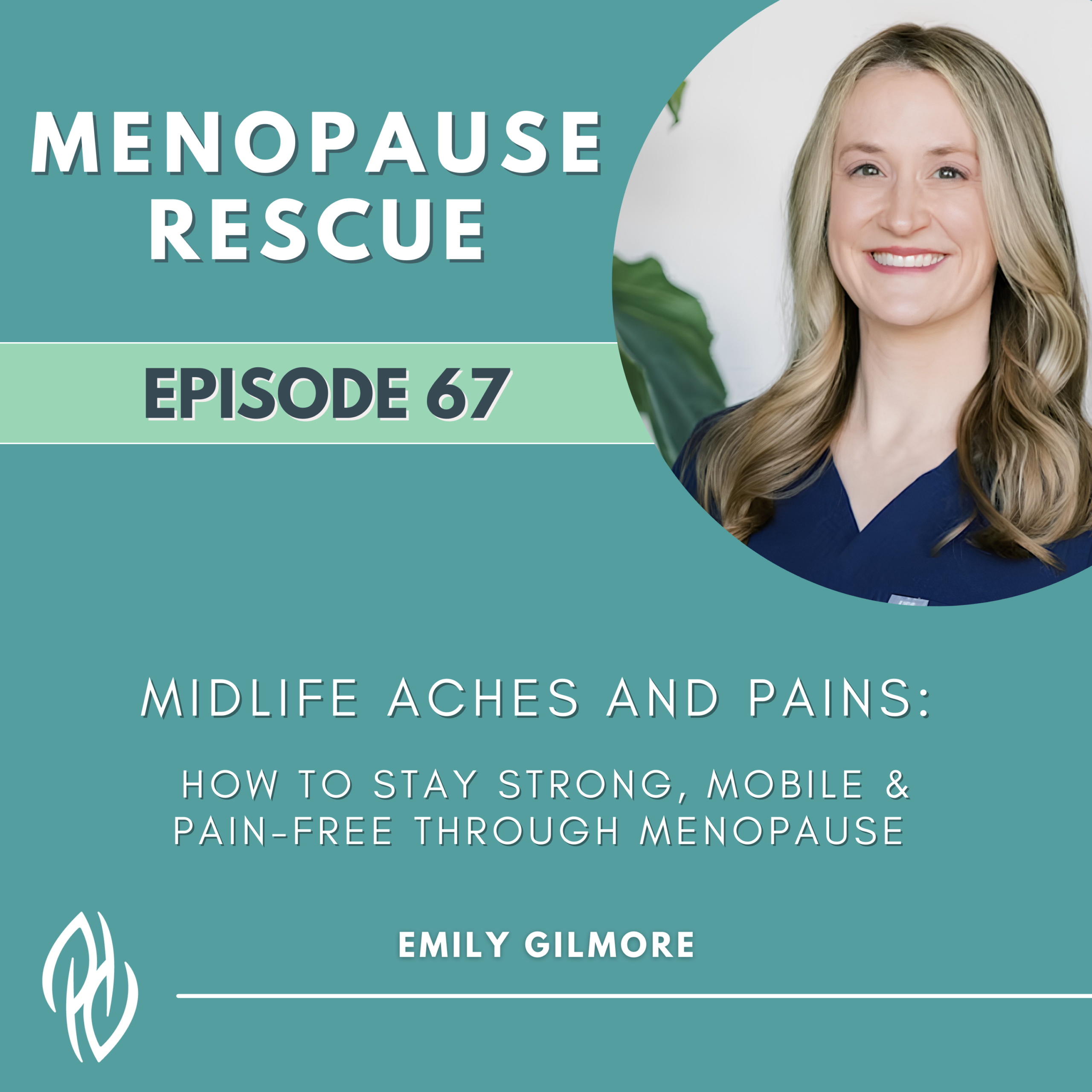
“There’s a certain point where the body can compensate for years—until it can’t,” says Emily Gilmore. In this episode, Emily Gilmore, a physical therapist specializing in women’s health, joins Kate Willis of Hormone Wellness MD to discuss musculoskeletal health during perimenopause and menopause. Emily highlights the importance of addressing muscle imbalances, building strength, improving mobility, and prioritizing recovery to prevent injuries and maintain independence as women age.
“The body can compensate for a really long time—until it doesn’t. And when it doesn’t, it gives you the middle finger and says, ‘I’m really tired of this.” — Emily Gilmore
The episode covers why aches, joint pain, and stiffness often become more common in midlife, the impact of hormonal changes on recovery, and practical strategies for protecting bones, muscles, and joints. Kate Willis and Emily Gilmore shed light on how progressive strength training, daily mobility work, proper ergonomics, and intentional recovery can help women stay strong, active, and resilient throughout midlife and beyond.
Watch The Conversation!
“There’s a certain point where the body can compensate for years—until it can’t,” says Emily Gilmore. In this episode, Emily Gilmore, a physical therapist specializing in women’s health, joins Kate Willis of Hormone Wellness MD to discuss musculoskeletal health during perimenopause and menopause. Emily highlights the importance of addressing muscle imbalances, building strength, improving mobility, and prioritizing recovery to prevent injuries and maintain independence as women age.
“The body can compensate for a really long time—until it doesn’t. And when it doesn’t, it gives you the middle finger and says, ‘I’m really tired of this.” — Emily Gilmore
The episode covers why aches, joint pain, and stiffness often become more common in midlife, the impact of hormonal changes on recovery, and practical strategies for protecting bones, muscles, and joints. Kate Willis and Emily Gilmore shed light on how progressive strength training, daily mobility work, proper ergonomics, and intentional recovery can help women stay strong, active, and resilient throughout midlife and beyond.
Quotes:
- “The body can compensate for a really long time—until it doesn’t. And when it doesn’t, it gives you the middle finger and says, ‘I’m really tired of this.” — Emily Gilmore
- “There are a lot of things that happen in midlife that are directly related to hormones. Then there are some things that happen simply because we’re more years old than we were 10 or 20 years ago.” — Kate Willis NP-C
- “We’ve got to have that parasympathetic, rest-and-digest component if we’re actually going to recover from exercise instead of becoming perpetually inflamed.” — Emily Gilmore
Disclaimer: https://hormonewellnessmd.com/podcast#Disclaimer
Meet the host!
Kate Willis, NP-C, IFMCP is a virtual nurse practitioner for Hormone Wellness MD. She’s been working in women’s health for 15 years in the field of gynecologic oncology and sexual wellness.
In 2021, Kate received her certification through the Institute for Functional Medicine (IFM), and is thankful for such solid and evidence-based training. She uses it daily in her care for patients as she works to address the root cause of disease and dysfunction in the body. As of 2024, she is also a Menopause Society Certified nurse practitioner who is ready to help with your perimenopause and menopause questions. Click here to become a patient!
I love working with women because I think women change the world.

Meet the Guest Speaker!
Emily Gilmore, PT, DPT, earned her Doctorate of Physical Therapy from UAB in 2012 and specializes in outpatient orthopedics and women’s health. She has advanced training in dry needling, soft tissue techniques, and pelvic rehabilitation. Inspired by her own postpartum experience, Emily developed a passion for prenatal and postpartum care and opened Thrive Physical Therapy in 2020. She takes a holistic, individualized approach to helping patients move better, feel stronger, and live well.

Meet the host!
Kate Willis, NP-C, IFMCP is a virtual nurse practitioner for Hormone Wellness MD. She’s been working in women’s health for 15 years in the field of gynecologic oncology and sexual wellness.
In 2021, Kate received her certification through the Institute for Functional Medicine (IFM), and is thankful for such solid and evidence-based training. She uses it daily in her care for patients as she works to address the root cause of disease and dysfunction in the body. As of 2024, she is also a Menopause Society Certified nurse practitioner who is ready to help with your perimenopause and menopause questions. Click here to become a patient!
I love working with women because I think women change the world.
Meet the Guest!
Emily Gilmore, PT, DPT, earned her Doctorate of Physical Therapy from UAB in 2012 and specializes in outpatient orthopedics and women’s health. She has advanced training in dry needling, soft tissue techniques, and pelvic rehabilitation. Inspired by her own postpartum experience, Emily developed a passion for prenatal and postpartum care and opened Thrive Physical Therapy in 2020. She takes a holistic, individualized approach to helping patients move better, feel stronger, and live well.